Guest Post by Derek Dreier: Herlin Riley, Evidence

Download the Transcription: Drums

Listen to the Solo

Watch a video of the solo being performed by Derek! – http://www.youtube.com/watch?feature=player_embedded&v=OAEaf_qHunU

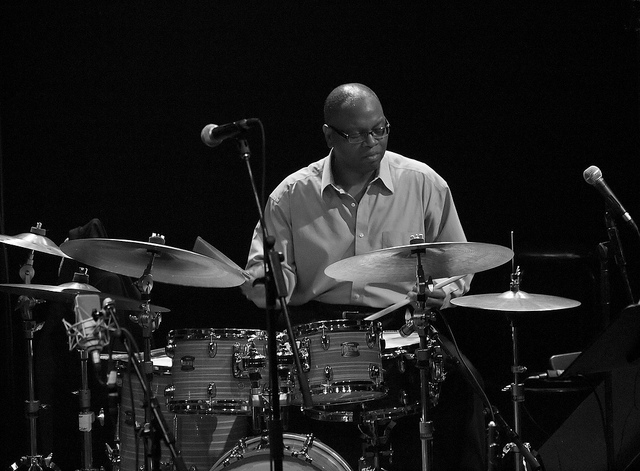
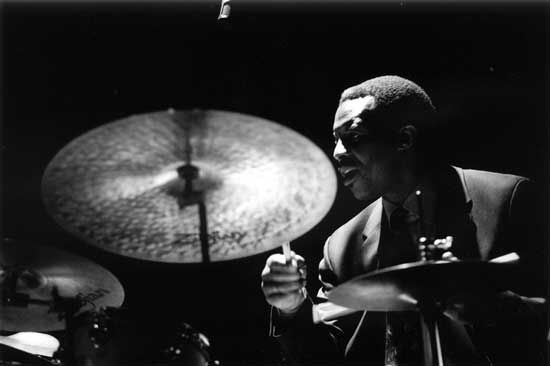
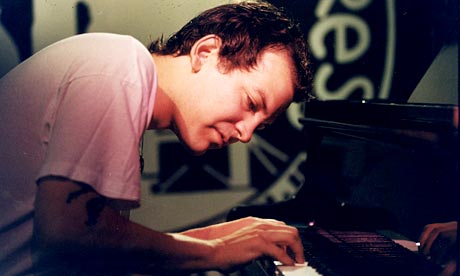
The transcription features Herlin Riley’s playing on “Evidence” from Wynton Marsalis Septet’s 1999 multi-disc release Live at the Village Vanguard. Monk’s writing, exemplified in “Evidence” is rhythmically unique, often jagged and deceptive, a quality which gives drummers many possibilities. Herlin’s choices are tasteful, organic and exploit the rhythmic opportunities Monk provides. Herlin plays with triplet vs. sixteenth and straight vs. swing ideas, and moves in and out of downbeat and offbeat oriented phrasing. All of which reflect the similar off-kilter effect the tune’s melody has. Also, notice the two busiest portions of the solo, (m.49-56 and m.73-76). The first example phrases triplets, with the latter phrasing sixteenths, demonstrating smart soloistic flow and development. With its phrasing, and creative rhythmic ideas, this transcription stands out as a fun and excellent example of musical drumming.

Guest post by Adam Spiers: John Coltrane, Blue Train

Blue Train - Blue Train
Dowlnoad PDF: Bass Clef

This submission is of an iconic solo played by John Coltrane and if you’re any kind of jazz fanatic it’ll be very familiar, but seriously–watch the video. Adam Spiers plays along with the solo, note for note, on the cello. As a cellist I find it difficult to describe just how insane this is, but to put it in perspective it’s kind of like climbing the stairs of the Empire State building in flip flops; it’s not impossible…but yeah. Wow. I’m very humbled to be posting this incredibly thoughtful and meticulous transcription along with such an amazing video, but unfortunately for you horn players out there the transcription is in C and an 8ve down. But you should still follow along and check out this amazing video and transcription. Probably twice.

With Adam’s permission I’ve pasted in the body text of his blog post on this transcription, which can be visited at its original location here: Cello Lessons from a Dead Genius. Continue reading

Guest Post by Dario LaPoma: Brad Mehldau, August Ending

Download the Transcription: Piano Score + Bass

Audio Link: August Ending

“August Ending” Brad Mehldau

For nearly two decades, composer-improvisor Brad Mehldau has left a prophetic mark on the music of our generation. One supporting reason is that his music strikes an emotional, spontaneous core while maintaining a structural quality evident through analysis. House on Hill was released by the Brad Mehldau trio (Rossy on drums) in 2006, and the opening track, “August Ending,” illustrates Mehldau’s search for “successful integration of composed and improvised material.”1 Feel free to decide for yourself, but I’m pretty convinced he’s on the right track.

The composition is bound together by a string of 8th notes (A-Bb), which while fitting colorfully into the harmony serve several foundational purposes throughout the tune. Continue reading

Guest Post from Jason Fabus: Kenny Garrett, There Will Never Be Another You

Download the Transcription: CBbEb

Audio Clip

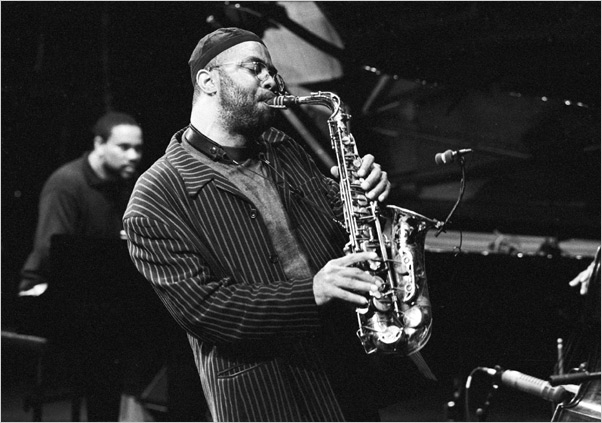
This is a transcription of Kenny Garrett’s (the REAL Kenny G!!!) solo on “There will never be another you” from Woody Shaw’s album, Solid (2009).  Garrett does a great rendition of this often heard standard.  Listen to his style and the way he shapes notes and phrases.  There are a great deal of scoops, accents, and slurred passages that will be thrown at you, which is always fun.  Also, listen to how Garrett uses rather simple, yet effective forms of chromaticism and “going out” to give this tune a nice remastering.

Guest Post from Jason Fabus: Cannonball Adderley, Corcovado Take 2

Download the Transcription: EbBbC

This is actually an alternate take of the Jobim standard Corcovado done by Julian “Cannonball” Adderley from the album Cannonball’s Bossa Nova.  It has got to be one of my favorite albums of all time, and Cannonball shows why.  He has a very effortless way of playing, especially when attacking a difficult passage.  Please do listen to the recording to hear this.  While I may have notated all the notes, Cannonball does a great deal of “ghosting” notes throughout the section, gliding from phrase to phrase.  Challenge yourself not only to perform the notes with accuracy, but also the the style in which Cannonball presents them.


Guest Post from Sumner Truax: Miles Davis, So What


(The solo starts around 1:33 in the video)

[Thanks to Sumner Truax for today's guest post!  Check out more of Sumner's transcriptions and phenomenal classical recordings over at www.sumnertruax.com]

Download the Transcription: BbEbC

Kind of Blue is one of the most iconic jazz albums recorded to date.  This track and this solo are probably the most well-known recordings on that album.  Miles is one of my favorite horn players because everything he plays sits so perfectly in the pocket.  On this recording especially you can hear him playing primarily on the back side of the beat.  It sounds so effortless!  This is also a great study in melodic development since most of these ideas are just triads!

Guest Post from Kevin Sun: Joe Henderson, Computer G

Audio clip: Adobe Flash Player (version 9 or above) is required to play this audio clip. Download the latest version here. You also need to have JavaScript enabled in your browser.

Download the Transcription: BbEbC

[Special thanks to Kevin Sun for today's guest post.  For more of Kevin's transcriptions and articles, be sure to check out his website at www.thekevinsun.com/]

From Kenny Garrett’s Black Hope (1992), Computer “G” is a 12-bar blues in F that has a simple melody based on ascending and descending stacks of perfect 4ths.

Joe starts his solo with a simple motif at B that he displaces rhythmically over the first few bars. He uses syncopation and repetition to develop this idea—basically 5-#4–5–1—in a way that’s swinging but not predictably so.

At C, Joe begins to break away from his opening motif by playing longer lines and arpeggios—check out the clearly outlined tritone sub in the 4th bar of C. Joe gestures towards his opening motif in mm. 31-2 and throws in a trademark trill in mm. 33-4 (can you think of any other tenor players who use trills as reliably and as tastefully as Joe?).

Continue reading

Park Evans, Could you be Deceived?

Satori for a Hungry Ghost - Parker Paisley

Audio clip: Adobe Flash Player (version 9 or above) is required to play this audio clip. Download the latest version here. You also need to have JavaScript enabled in your browser.

Download PDF: ConcertBass ClefBbEb

This is another track off the album Sartori for a Hungry Ghost by local (Twin Cities) jazz/reggae group Parker Paisley (Park Evans, Guitar; Adam Wozniak, Bass; Brandon Wozniak, Tenor Sax; Pete Hennig, Drums), released April 2012 and recorded by Greg Schutte at Bathtub Shrine Studios in NE Minneapolis.  I love listening to this entire album so definitely check it out–and if you like this solo then you’ll want to see/hear Adam Wozniak’s bass solo on the tune Third Persona, which I posted a month and a half ago. One of the really cool things about Park’s solos on this album is that they’re all different–in style and tone.

Continue reading

Dexter Gordon, Love For Sale


Audio clip: Adobe Flash Player (version 9 or above) is required to play this audio clip. Download the latest version here. You also need to have JavaScript enabled in your browser.

Download the Transcription: Bb, C, Bb_8vb, Eb

I’ve always loved this solo and when I had to pick a tune to memorize and perform in my improvisation class back in 2006, I jumped on the opportunity to learn this one. Dexter has this uber hip, uber cool way of playing that is so attractive to me. In one line he can play something totally inside the groove and in the next he’s laying his lines so far back the band finishes the tunes before he does. Continue reading

Joshua Redman, Straight, No Chaser (pt 1)


(The transcription starts at 1m35s in the video.)

Download the Transcription: Bb, Eb, C, Bass Clef

This is a great tenor battle between Joshua Redman and James Carter on the classic Monk tune “Straight, No Chaser.” This first transcription is only Joshua’s first four choruses. I’m planning on completing most (if not all) of the rest of this video over a series of 4-5 parts since it is quite lengthy.

Redman and Carter clearly have different approaches to the instrument and I find it very interesting to see how one kind of leads the other. In an aesthetic sense, I definitely prefer Redman’s style over Carter’s, but the two are so different and both players are clearly talented that I think it’s useless to talk about who “won” the battle. Though, if you read the youtube comments you’ll see there are fierce defenders in both camps. I think both players offer plenty to learn from. More to come in following posts. Happy shedding!